|
|
|
|
Original Article
Earthen Architecture in India: Revival, Relevance and Contemporary Practice
|
Ankit Somvanshi 1* 1 Research Scholar,
Department of Plastic Arts, Banaras Hindu University, India |
|
|
|
ABSTRACT |
||
|
This research paper scrutinises the evolution of architectural trends in India, transitioning from the post-colonial embracement of concrete skyscrapers to a reinvigorated focus on traditional mud houses. It explores the socio-cultural, economic, political, and environmental motivations driving this shift and underscores the significance of indigenous practices in contemporary architectural discourse. The aim is to contextualise the architectural developments of modern India within the broader historical continuum that informs its current reversion to vernacular methodologies. Keywords: Vernacular Architecture, Sustainable
Design, Cultural Heritage, Eco-Friendly Construction, Modernism, Le
Corbusier, Louis Kahn, Auroville, Traditional Building Techniques |
||
INTRODUCTION
Indian
architecture has undergone a dramatic transformation over the past century,
reflecting the nation's rapid urbanisation and subsequent socio-economic
changes. Initially dominated by concrete skyscrapers, a symbol of modernity and
progress, there has been a discernible shift towards ecological and culturally
resonant building practices, notably mud houses. This paper examines the
drivers behind this revival and the implications for sustainable urban
planning.
LITERATURE REVIEW
The trajectory of
Indian architecture has been significantly influenced by global and local
forces. From the ancient rock-cut caves to modern skyscrapers, the
architectural landscape in India is a testament to a rich historical legacy and
dynamic cultural exchange Mitter
(2001), Danielewski (2009).
The reintroduction of mud houses in contemporary settings, despite the
prevalence of modernist architecture, points towards a critical evaluation of
sustainability and cultural identity in architectural practices Ching
(2007), Joseph
(2018).
METHODOLOGY
The study employs
a qualitative approach, analysing architectural trends through a combination of
historical document reviews and contemporary case studies. Observations from
significant projects and practices, such as those by Le Corbusier in Chandigarh
and the vernacular architecture in Auroville, provide empirical insights into
the ongoing architectural transformations.
MAIN BODY
Indian
architecture has witnessed remarkable developments over the years, reflecting
cultural, technological and economic changes within the society. The dominance
of concrete skyscrapers in recent decades has been a testament to India's rapid
urbanisation and modernisation. However, alongside environmental problems,
there is also a shift in people's aesthetic sensibilities, with a desire to
live closer to nature; this is also a reason for turning to Vaastu based on
natural principles. India has been a place from an architectural perspective,
where one can see everything from rock-cut caves to temples, arches, domes,
dargahs, baolis, and skyscrapers, all on one land.
But this is just one side of the coin; the other side is even bigger and more
ancient, that is, the local mud houses here.
These are as
diverse as the climate here. If we start from the north, then from the Buddhist
monasteries built in Leh to the use of glazed slabs of wood and slate for the
roof, along with mud-mortared stone walls in the region of Himachal, it is
worth seeing. In North India, Central India, and Rajasthan, thick mud walls
with thatched roofs later became terracotta roofs, which, by the time they
reached South India, were transformed into thick wooden pillars used in
courtyards and verandahs. gets to. On the other hand,
the abundance of bamboo in Assam, Meghalaya, Bengal, and Orissa seems to add a
new colour to the architecture there.
We find that we
have had such a huge collection of local architecture for centuries, but after
colonialism, independence and the industrial revolution, the biggest change
that came in the whole world, from which even India was not untouched, was
steel, cement and glass. These three discoveries and their production changed
the entire world of architecture. It left behind all the ancient media because,
in some ways, it proved better than them: multi-storey buildings could be built
with it, and it would take less time to build. These new modern media were
easier to transport from one place to another, and fewer artisans were
required. But these were its immediate benefits; in the long run, it proved a
curse for the environment and for humans. Because carbon emissions increased in
the production of cement, steel, and glass, these materials are not suitable
for every environment. Before the Industrial Revolution, the materials and
media used in architecture were sourced from the surrounding environment. Which
proved to be effective for the climate there in every respect. The second major
problem with these media is that, once used, they are not reusable and do not
mix easily with the environment, becoming a major source of pollution. Now, you
take cement itself, it is made in the form of a combination of fine powder by
breaking different rocks, and when it comes in contact with water, it undergoes
chemical reactions
and takes a shape
and form, but once it completes its process completes. After that, it cannot
revert to the same rock or mountain. You can understand that destroying the
mountains of any other place for the construction of another country or city is
equivalent to destroying both the climate and culture of that place. We call
this phenomenon development. Want to forget something. The whole world was
going through this period of development, so India was part of it, and it was a
period of modernity and industrialisation.
One of the
prominent figures in giving Indian architecture a new direction and condition
was Le Corbusier. Jawaharlal Nehru was an important figure among the leaders
who brought India to independence. This was the period when, before liberating
India, the British divided India into two parts in the form of Pakistan, and
the result was. became very serious in the form of Hindu, Muslim, Sikh riots
and the whole world saw it and India's sovereignty and identity was deeply
hurt.
Amidst all this,
India became independent, and to introduce the new identity of this independent
India on the world stage, the concept of establishing Chandigarh was a boon for
both politicians and planners. Its foundation stone was laid on 2 April 1952 by
the then Prime Minister, Pt. Nehru did this in a crowd of millions of fans. The
news was published and discussed in politics, newspapers, and among common
people across India. On one hand, there were praises; on the other hand, the
press ridiculed such long roads of the city, because when the construction work
started in 1956, there were not so many vehicles in the city." On the
other hand, India had just become free from slavery at that time and basic
needs like unemployment, health and food were yet to be met in the country and
under these circumstances, people were also reluctant to spend so much money on
such a big and expensive project.
The construction
material used in the building, i.e., the use of cement concrete, was not
appreciated because, among the Indian people, it looked dull, and the
architecture appeared to be a monument. Just as art is an expression of
society, any hope or tool used is not merely an object of use for a few people
but a researcher of the entire social scenario; in the same way, architecture
is not just a place to live but an expression of the entire culture. Because
everyone would be associated with it, people from every section of society.
Despite all these being connected, people would have different roles with
Vaastu, like for its architect it would work in a different way, as if it was
the embodiment of the expression of his thoughts, while for the workers who
built it it would be a
Employment opportunity would have provided a different perspective for the
socialists and thinkers and all these things together would have made the
architecture a cultural identity rather than just an architecture. For that
civilisation and society.
But the
architecture being created in Chandigarh did not have its origins in India and
was entirely derived from the West, because its planners did not grow up in an
Indian environment, nor were they familiar with the ancient architecture here.
Therefore, their
craft language was strongly rooted in cubes, solid shapes, and geometric
shapes, which were, to some extent, unnatural. It was his belief that buildings
should stand out from nature, not merge with it. Their inclination has always
been towards abstract painting and sculpture; hence, he seems to be greatly
influenced by the avant-garde art born in Europe. This is clearly visible in
the architecture of the Herm Capital Complex and the colourful, massive doors
and tapestries of the Legislative Assembly. Although these experiments were
very important for the modern world and the industrial age, but in its initial
phase it seemed a completely new phenomenon to the Indian people. The
construction material used in building construction, i.e., cement, was not
appreciated; perhaps its colour was the main reason. Le Corbusier's own
understanding of architecture can be understood from his statement. In his
definition of "home" he calls home a machine in which we can live.
Secondly, he avoids building that kind of architecture that is stuck to the
ground; he lifts the entire architectural structure from ground level into the
air with the help of pillars, making it appear to float. Amidst all this, in
the era of modernity, we should not forget another important architect. Despite
not being of Indian origin, he understood the environment of India very well;
his name was 'Louis Kahn'. He was admitted to IIM by Vikram Sarabhai in 1961.
He was called to
build the Ahmedabad project. designing IIM., he toured India for six months
which included visiting Vijayanagar, Fatehpur Sikri and used these
architectural elements in his architectural plan. His architecture is known not
only in the Indian landscape but also all over the world for its use of shadow
and light inside and outside. And the medium he chose for his architectural
craft was brick and he did not cover the surface of the brick with cement
plaster but used it neatly in such a way that it gives a distinct identity and
aesthetic sense to his architecture. He made extensive use of big arches and
geometry in his architecture, but this is different from Lee's geometric
experiments. Since its medium is irregular, it appears more organic. Another
special thing about his Vaastu is that he gives great importance to open space
along with Vaastu, he believes that openness of ideas for teacher- student
communication along with physical form is also an important point for any
Vaastu. Conclusion: By keeping these two architects as examples, we can know
that this was the beginning of the construction of multi-storey buildings in
India.
Here, we explore a
selection of notable institutions and organisations that are at the forefront
of this movement:
1)
Auroville
Earth Institute (AEI)
Located in
Auroville, Tamil Nadu, AEI stands as a pillar in the field of earth-based
construction. Renowned for its development and promotion of Compressed
Stabilised Earth Block (CSEB) technology, AEI conducts a range of workshops and
training sessions to disseminate knowledge and skills in sustainable building
practices. Its efforts are instrumental in blending traditional methods with
modern technologies to achieve ecological and economical construction
solutions.
2)
Hunarshala Foundation
Based in Bhuj,
Gujarat, Hunarshala Foundation integrates traditional
knowledge and contemporary engineering to rebuild and empower communities
affected by natural disasters. The foundation’s work encompasses training
artisans and masons in sustainable building practices, focusing on technologies
such as adobe, rammed earth, and bamboo construction. Hunarshala’s
community-driven approach ensures that the skills needed for sustainable
building are rooted in the cultural fabric of the regions they serve.
3)
Development
Alternatives (DA)
This Delhi-based
research and action organisation is dedicated to sustainable development
through innovative economic, social, and environmental strategies. Development
Alternatives has pioneered the development of technologies and solutions, such
as compressed earth blocks and other low-energy building materials, that are
both environmentally friendly and culturally appropriate. The organisation
conducts workshops and training programs to promote sustainable development
practices among rural communities.
4)
Thannal Hand Sculpted Homes
Located in
Tiruvannamalai, Tamil Nadu, Thannal is a grassroots
movement dedicated to natural building techniques. Founded by architect Biju
Bhaskar, Thannal promotes the use of indigenous
materials and techniques through workshops and awareness programs. The
organisation’s focus is on mud architecture, lime plaster, and other
traditional Indian building methods, serving as a repository of knowledge and a
catalyst for the revival of heritage building practices.
5)
Nirmiti
Kendra
Founded in Kerala,
Nirmiti Kendra has been instrumental in promoting cost-effective and
environmentally sustainable building technologies. The organisation specialises
in training programs and the development of innovative construction materials
and techniques, including mud-based construction. It seeks to transform
Kerala's building landscape through community-centred educational initiatives.
6)
The
Centre for Green Building Materials & Technology (CGBMT)
Is a non-profit
organisation located in Bengaluru, India, established in 2004 with the aim of
advancing environmentally responsible construction practices. The institution
focuses on reducing the ecological impact of the built environment by promoting
low-energy building systems and sustainable alternatives to conventional,
resource-intensive materials. CGBMT operates through multiple interconnected
domains, including public education and advocacy on sustainable lifestyles,
equitable resource use, waste management, and environmentally sensitive
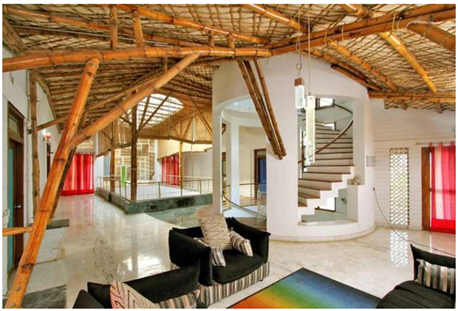
materials Figure 1. A significant component of its work
involves capacity building through specialised training programmes in Bamboo
Application Technology, designed to equip students and professionals with
technical and entrepreneurial skills related to bamboo-based construction. The
organisation also undertakes research and experimentation in eco-materials and
sustainable construction methods, provides consultancy services for the design
and implementation of ecological habitats, and collaborates with governmental
and policy institutions to support the inclusion of bamboo and green building
technologies within formal regulatory frameworks. In addition, CGBMT organises
community-focused workshops, exhibitions, and experiential learning events,
such as Bamboo Habba, to disseminate practical knowledge. Among its
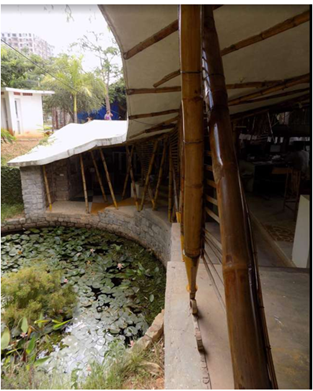
demonstrative initiatives, the House of Five Elements Figure 2 serves as a prototype of sustainable
residential architecture, integrating the principles of earth, water, air,
fire, and space through the use of materials such as mud, bamboo, stone, and
green roofing systems, with bamboo employed as a structural and architectural
element to demonstrate its applicability in energy-efficient housing.
|
Figure 1
|
|
Figure 1 CGBMT, Bangalore |
|
Figure 2
|
|
Figure 2 House of Five Elements, Banglore |
Among these, the
most effective and regularly functioning one is the Auroville Earth Institute
located in Tamil Nadu. The Auroville Earth Institute (AEI), nestled within the
experimental township of Auroville in Tamil Nadu, India, stands as a beacon of
sustainable building practices and earth-based architectural innovation.
Established in 1989, the institute draws inspiration from the visionary
principles of Auroville’s founder, Mirra Alfassa, famously known as "The
Mother," and is dedicated to the research, development, promotion, and
transfer of earth-based technologies, which are cost-effective and
environmentally sustainable.
AEI is renowned
for its pioneering work in the field of Compressed Stabilized Earth Block
(CSEB) technology. This method enhances traditional earth construction
techniques by stabilizing the soil with a small amount of cement, thereby
improving durability while maintaining ecological benefits. The institute’s
approach encapsulates a blend of ancient wisdom and modern scientific
practices, aiming to address contemporary construction needs without forfeiting
environmental integrity.
Under the
stewardship of Satprem Maïni, a disciple of renowned
architect Roger Anger, AEI has flourished as a center
of excellence. The institute offers a broad spectrum of training programs,
workshops, and seminars that disseminate knowledge about sustainable building
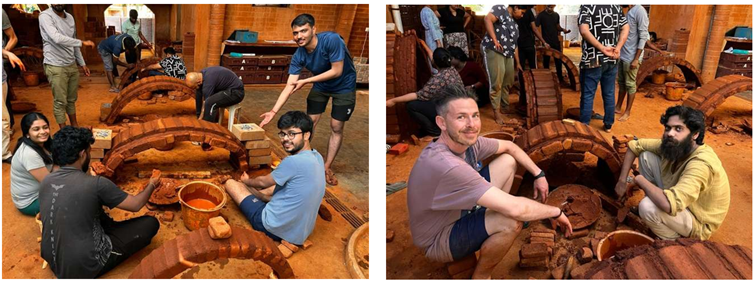
techniques to a global audience. These educational endeavors
are crafted to empower individuals, ranging from architects and engineers to
builders and students, equipping them with the skills necessary to implement
sustainable building practices in their own communities.
|
Figure 3
|
|
Figure 3 Student Working in
Aurovile Earth Institute |
AEI’s work has
garnered recognition and accolades from numerous entities, reflecting its
profound impact on the field of sustainable architecture. The institute not
only exemplifies innovative approaches to earth architecture but also embodies
the ideals of Auroville, promoting harmony between human habitats and the
natural world. As such, AEI continues to be a pivotal element in the evolution
of sustainable building, advocating for a future where architectural practices
are aligned with the principles of ecological stewardship and sustainability.
Different types of
courses are conducted here throughout the year, the main ones being (CSEB)
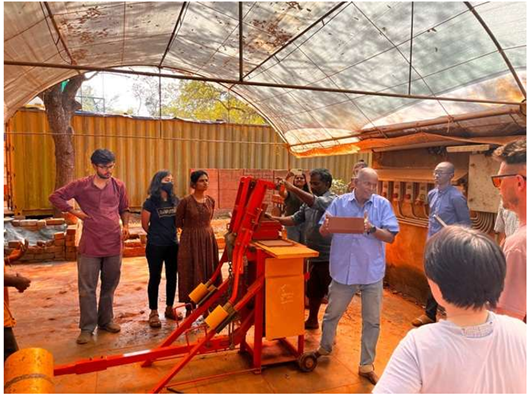
Compressed stabilized Earth Block. Under this, the soil is compressed and molded into the shape of irons. goes. But this brick is
completely different from baked bricks in terms of environmental harm because
the possibility of carbon emissions in this process is greatly reduced. They
organize AVD (Arch, Vault & Domes) workshops as another important course.
Under this, it teaches how to make arches and domes with a combination of
traditional and scientific methods. These are just a few examples of such
efforts being made all over India which confirm that in the coming times, mud
houses will be popular among the common people but its form will be changed.
CASE STUDY ANALYSIS
Examining projects
like the construction of Auroville, which integrates traditional architectural
elements within a modernist framework, illustrates the practical applications
of merging old and new building methodologies. The analysis extends to the works
of Sculptor Deepak Anand, who completed both his Bachelor’s and Master’s
degrees in Sculpture from Banaras Hindu University, currently works as an
independent practitioner engaged in site-specific and material-based projects
across various regions of India, including Tamil Nadu and Ladakh. His practice
reflects a sustained engagement with earth-based construction and vernacular
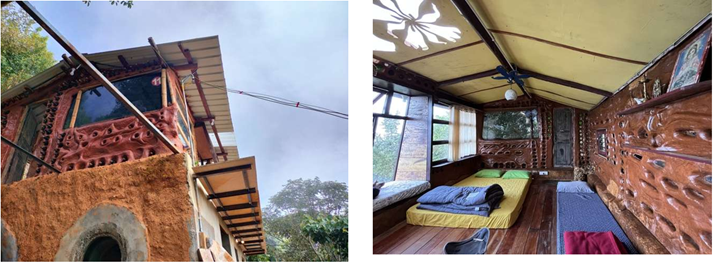
building techniques. One notable example of his work in sustainable habitat
design is Shujata Cottage Figure 5, a mud house located in Kodaikanal, Tamil
Nadu, which demonstrates the application of traditional earthen construction
methods adapted to local climatic and environmental conditions. The project
exemplifies the integration of sculptural sensibility with ecological
architecture, highlighting the potential of mud as a viable material for
sustainable residential structures.
|
Figure 4
|
|
Figure 4 Compressed Earth
Block (CSEB) by Auram Press, Earth Institute Aurovile |
|
Figure 5
|
|
Figure 5 Shujata Cottage,
Kodaikanal, Tamil Nadu |
1)
Ecological
and Economic Considerations
India is
confronted with critical challenges like swift urbanization, environmental
deterioration, and a shortage of housing. Mud houses and other sustainable
housing forms present effective solutions to these issues. They use
locally-sourced materials that are not only economically viable but also
environmentally friendly due to their minimal carbon emissions. With growing
concerns about climate change and resource scarcity, the transition to
sustainable construction practices is becoming increasingly necessary.
2)
Technological
Developments
Technological
progress is improving the practicality and attractiveness of mud houses.
Contemporary methods like stabilized mud blocks, enhanced rammed earth, and
various hybrid techniques are boosting the durability and structural integrity
of constructions based on earth. These advancements are making mud houses more
resistant to climatic conditions and seismic events, thus mitigating one of the
traditional limitations of earth construction.
3)
Cultural
Affinity and Social Acceptance
In many regions of
India, there is a profound cultural appreciation for mud houses, tied to their
aesthetic and climatic benefits. As urban populations become more
eco-conscious, there is an increasing valuation of homes that not only minimize
environmental impact but also offer health advantages like natural humidity
control and the use of non-toxic materials. This cultural and social shift is
aiding the broader acceptance and resurgence of mud houses.
4)
Educational
and Cooperative Initiatives
Educational
entities and NGOs are vital to the sustainable housing movement through their
research and educational workshops on sustainable building techniques.
Collaborative efforts among architects, academic institutions, and local
communities are driving innovation and spreading knowledge about sustainable
practices. These educational initiatives are crucial for preparing the next
generation of builders and homeowners to embrace sustainable living.
5)
Challenges
and Prospects
Despite the
positive outlook, there are obstacles to overcome, such as the stigma that mud
houses are primitive or inferior. It is vital to dispel this notion and
showcase the modern capabilities and comfort of mud houses. Additionally,
logistical challenges like standardizing construction practices and ensuring
quality control in remote locations require meticulous management. The
trajectory of mud houses and sustainable housing in India is closely linked
with the nation’s commitment to sustainable development. As environmental
consciousness and technological progress advance, mud houses are increasingly
becoming a preferred option in both rural and urban areas. Their transition
from traditional to modern sustainable architecture signals a greener, more resilient
future for India’s housing sector.
CONCLUSION
After this,
cement, steel and mirrors were used so much in government and private sectors
all over India that today Wherever you look, this is what you will see and it
took almost a hundred years for this spread to happen, but now people seem to
be getting more attracted towards other mediums. People are getting attracted
towards mud, stone and natural mediums but such houses are not commonly seen in
cities, they are being used by people as resorts, hotels and out houses. People
now enjoy spending time with this type of Vaastu. To give shape to this type of
Vaastu, architects are making traditional artisans a part of their plans. Due
to which their employment opportunities are increasing. Some private groups are
training and making people aware through workshops, small projects and
dialogues. Most of the participation in this is done by youth, most of them are
working in self- sustaining groups. Some of their names are Dharti, Earth
Building, Thanal Mud Home, Dharti Hands and Auroville
Earth Institute.
ACKNOWLEDGMENTS
None.
REFERENCES
Allen,
L. (2015). Lives
of the Artists, Lives of the Architects. Penguin
Books.
Arnheim,
R. (n.d.). The Dynamics of Architectural form (2nd ed.). University of California Press.
Bachelard, G. (2009). The Poetics of Space (M. Jolas, Trans.).
Penguin Books.
Baker,
L. (2023). Truth
in Architecture (p. 57). Jyotsna Prakashan.
Ching,
F. D. K. (2007). Architecture: Form, Space and Order
(3rd ed.). John Wiley and Sons.
Fassbender, F. (2014). Auroville Architecture: Towards
New Forms for a New Consciousness. Prisma.
Joseph,
T. (2018). Early Indians. Madansonimjul Publishing House.
Mitra,
S. (2002). World
Heritage Series: Fatehpur Sikri. Archaeological Survey of India and Good Earth
Publications.
Mitter,
P. (2001). Indian
Art. Oxford University Press.
Obrist,
H. U. (2015).
Lives of the Artists, Lives of the Architects.
Penguin Books.
Safvi,
R. (2021). A
Saint, a Folk Tale and Other Stories (p. 13). Rupa Publications.
Scriver,
P., and Srivastava, A. (n.d.). India:
Modern Architectures in History. Reaktion
Books Ltd.
Sharma,
S. (2014). The Cobb’s Capital (R. Manot, Trans., p. 40). A3 Foundation.
Sri Aurobindo. (2015). Auroville Architecture. Prisma Publications.
|
|
 This work is licensed under a: Creative Commons Attribution 4.0 International License
© ShodhShreejan 2026. All Rights Reserved.